Non Declarative memory

Non Declarative memory

=skills or behaviours obtained from past learning and experiences that are expressed by their performance and not their recollection

The learning of these kind of memories are done gradually by finding ant taking out common parts of similar events.

This learning is usually done unconsciously.

One example is learning to ride a bike.

By riding it multiple times, the individual will, unconsciously, start riding it in ways that doesn’t make them fall and not do things that make the, fall.

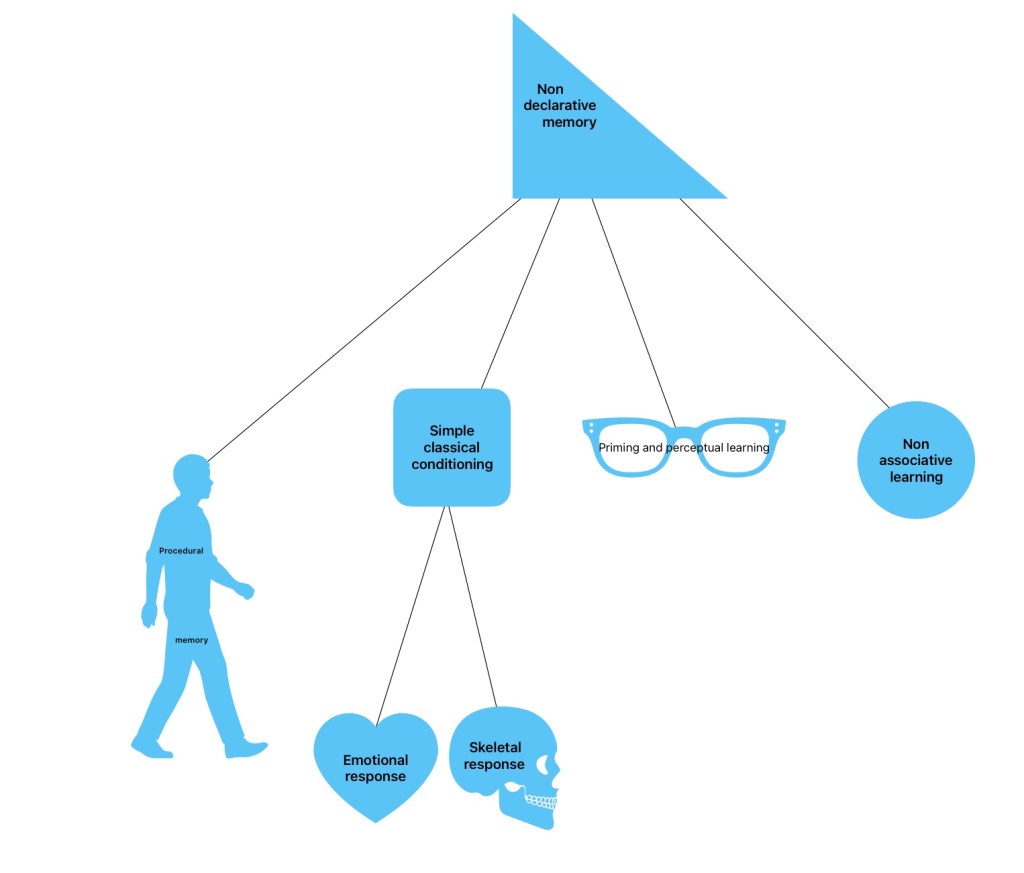
The four subcategories of non declarative memory are :

Procedural memory

= cognitive and motor skills or abilities

Often used example are knowing how to ride a bike or how to run

It’s main region is the striatum

Priming and perceptual learning

= when a perceived item unconsciously influences behaviour, actions or thoughts in response to later events and objects

For example, when hungry, an individual will recognise food related words faster than non food related words.

The main region used is the neocortex.

Non associative learning

= learning that doesn’t involve conditioning or any association. It has two subtypes : habituation and sensitisation.

Habituation is getting used to something and recognising it less, like the noise of cars when living next to a busy road

Sensitisation is the opposite where the reaction to something gets stronger and stronger.

The main region activated is the reflex pathways

Simple classical conditioning

= when an item, sound, smell… causes an unrelated response due to repeated association of it with something else.

Pavlovs dog is a famous example where the dogs would produce more saliva in reaction to a bell sound after many experiences of hearing it before being given food

Simple classical conditioning has two subtypes.

Emotional response

The amygdala is the main region for this.

Skeletal response

= a physiological response

The cerebellum is mainly activated.
Declarative memory

The biological systems of long term memory

Declarative memory

Declarative memory

= the ability of recalling events and facts consciously

Declarative memory mainly uses the medial temporal lobe and the diencephalon

Medial temporal lobe

=a part of the temporal lobes ( in the sides of the head ) that has the hippocampus, amygdala and Parahippocampal regions and is important in memory and learning

Diencephalon

=a brain region consisting of the epithalamus, hypothalamus, thalamus and subthalamus.

It is in a central position in the brain. It relays information to the cerebral cortex and releases hormones.

It is the main memory system to be damaged by amnesia.

Amnesia

= partial or complete loss of memory/ memory ability

The conscious aspect is important in defining declarative memory and enables the use of retrieved information such as comparison or contrasting.

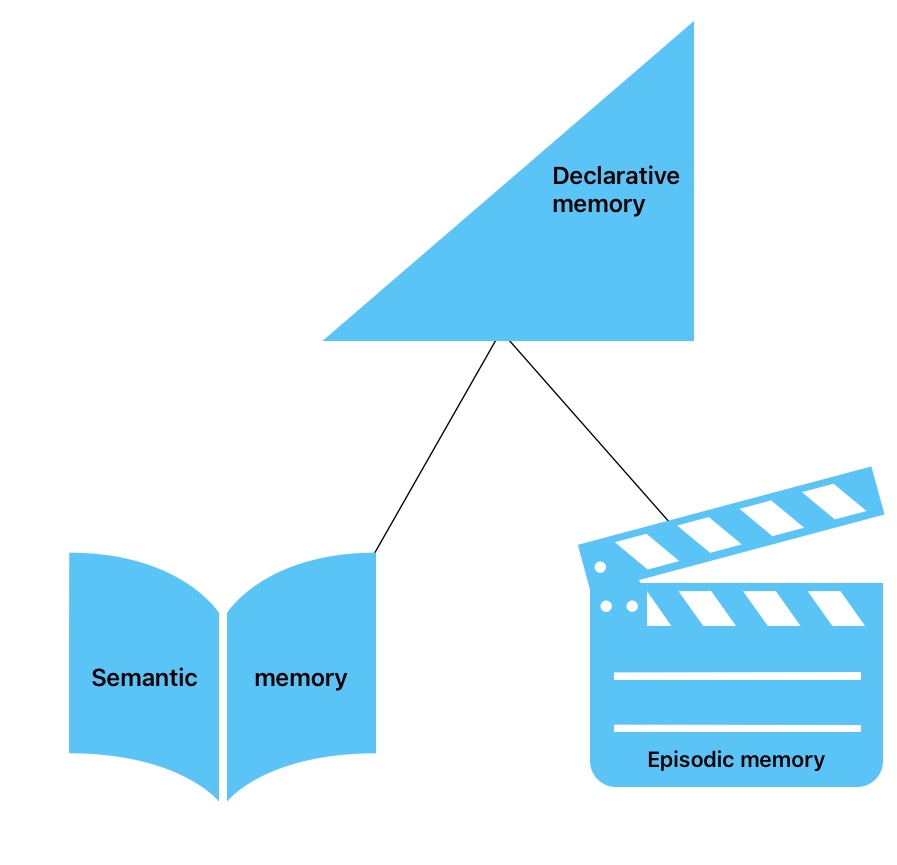
The two subcategories of declarative memory are :

Semantic memory

= knowledge, information about things that get recalled independently of a past experience

Episodic memory

= a memory of an event in the past experienced directly

While they both use different content, episodic memory can also be seen as semantic memory with additional information about the context.

This may be why episodic memory uses the same brain regions as semantic memory with the addition of other brain regions such as the frontal lobe.

Frontal lobe

= the front part of the brain involved in higher level executive functions such as language and thoughts.

Non declarative memory

The biological systems of long term memory

The biological systems of long term memory

Introduction

Long term memory is where all information and experience acquired is stored. That is a lot of information and many different types of content and to have all of it in one seems very unnatural. That is why, scientists have been categorising memory for a long time.

This page the first part of a study of this article

Memory systems of the brain : a brief history and a current perspective by LR Squire

Context

Memory can be divided into the sensory register, short term memory and long term memory.

Long term memory itself has categories of its own.

The current categorisation is based on the mainly activated brain regions for the memory. It has itself been modified from its original appearance in 1987.

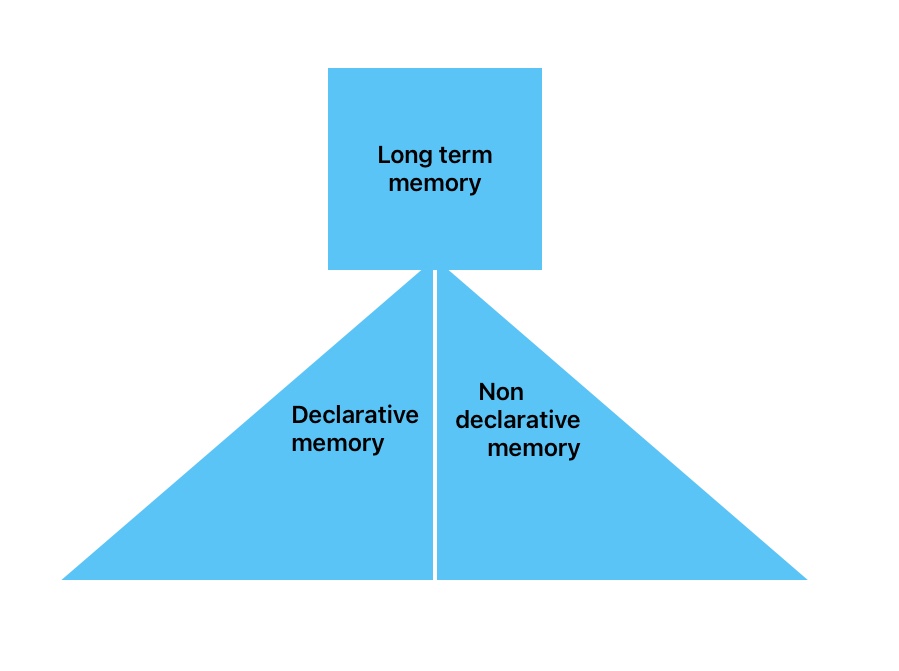
Long term memory can be divided into two.

Declarative memory

=the ability of recalling events and facts consciously

Click here for more

Non declarative memory

= skills or behaviours obtained from past learning and experiences that are expressed by their performance and not their recollection

Click here for more

Both of them have subcategories.

Click on the system you want from above to learn more!

They are two distinct memory systems.

However, they both work to create and maintain behaviour and character.

One event can also create both kinds of memory.

For example, a scary event can create an episodic memory ( declarative ) and a phobia which can be included in simple classical conditioning ( non declarative ).

Which memory system is used can make us learn differently.

Such as in better or worse / conscious or unconscious learning / related to or distinct to other knowledge…

For habit learning tasks which were set at a high difficulty, participants of the experiment were found to use the medial temporal lobe, used for declarative memory, at the beginning.

However, this reliance gradually decreased and the activation of the neostriatum, used for procedural memory was gradually increased.

Next Part : Until the current systems of memory

Why do we need systems of memory?

This is the final part of a study of these two articles.

What are the differences between long-term, short-term, and working memory? By Nelson Cowan

50 years of research sparked by Atkinson and Shiffrin (1968) By Kenneth J. Malmberg & Jeroen G. W. Raaijmakers & Richard M. Shiffrin

Discussion

As in the title of one of the articles, it has been a long time since memory has been divided into groups.

These aren’t the original groups as they have been updated with more recent research. Long term memory has also been subdivided into several groups.

Why do we divide memory into groups?

There are a few reasons for this

1. The brain

The brain regions used in each memory system aren’t identical. Some brain regions may be active in all systems but others only for one of them.

One famous example is the medial temporal lobe which contains the hippocampus, amygdala and parahippocampal regions which is active in short term memory.

However, an individual named HM had a part of it removed. He was able to remember most of his past and had close to average cognitive abilities. His short term memory was also fine.

The problem was that he couldn’t create long term memories anymore. His memory was blocked at the point of the accident that led him to the operation.

This meant the role of the hippocampus was in the transition of short term memory to long term memory.

2. Functions

The different memory systems are all called “memories” although their functions are clearly different.

The sensory register is for perception of the environment ,

the short term memory is to keep track of what is happening in our heads and outside and

the long term memory is where all our experiences and knowledge is stored.

The information in each also moves from system to system in a specific way.

Information in the sensory register moves to short term memory once we pay a little more attention to it than other items we perceive.

That can then move onto the long term memory if we think about it repeatedly, not necessarily in the same form each time.

The long term memory can also send information to the short term memory to be used in problem solving, creative thinking etc.

3. Research

Ultimately, these divisions are to clarify the concept of memory and make it easier to study.

A world where none of these distinctions exist would lead to confusion as some researchers could use the term “memory” to talk about short term memory in a paper and others could think of it as long term memory. Making the discovery wrong.

Why study the different systems of memory ?

This has a pretty simple answer.

Studying memory and finding out how it works and what it is made of will help us understand the problems it can have and treat them and also how we can improve it.

The ability of complex thinking is one of the traits that distinguishes humans and other living beings.

We may think, long term memory that provides information for it would be the only one we should study.

However, short term memory is where the thinking happens and is also a stage information needs to go through to arrive to the long term memory.

The sensory register is what enables us to react to the world and collect information that may or may not be stored longer.

For long term memory and thinking, all stages of memory are necessary. The systems are all completely different but in the same time, are all a part of one thing.

Which is the reason to study that one thing which is memory.

First part : Memory, from fractions of a second to an eternity. Also is memory = intelligence?

Second part : When does short term memory become long term?

Third part : How much can we keep in short term memory ?

How much can we keep in short term memory ?

Introduction

This is the third part of a study of these two articles.

What are the differences between long-term, short-term, and working memory? By Nelson Cowan

50 years of research sparked by Atkinson and Shiffrin (1968) By Kenneth J. Malmberg & Jeroen G. W. Raaijmakers & Richard M. Shiffrin

Context

Capacity is the second limit of our short term memory.

In conditions of free recall or longer lists (≈ larger amounts of information), capacity will be the dominant limiting factor.

Our short term memory is a way of keeping information so that it can be needed immediately.

This can only be done for a limited amount of information.

One example of this is the magical number 7+/-2

7+/-2

This amount was used as a representation of how many different items or ideas could be kept in ones mind at the same time

However, George A. Miller, the psychologist behind this number, revealed it was more of a way to explain his ideas than a well studied result

Recent studies have shown 3 or 4 to be more realistic.

For example, studies have shown :

  • 7 item lists usually are remembered with some errors

3 item lists are mostly recalled without any mistakes

  • Retrieval of information ( from long term memory) is usually done in blocks of 3s

This capacity isn’t the same with every person or situation.

In adults, this number generally varies between 2 and 6.

It was found to be related to cognitive abilities, thus people with high cognitive abilities will be able to retain a bit more than people with lower abilities.

Information can also be subject of chunking

Chunking ( grouping )

= when similar or related information are remembered together

At first glance, this seems as a way to increase the “magical number”.

However, chunking needs items to be put into awareness multiple times to be compared.

The problem is that this is also a form of rehearsal.

Ways of preventing rehearsal from this perspective are :

  • Rapid presentation of the items
  • Presenting the items in a perceivable manner without having the participants pay attention to them

Different senses

Everyday information doesn’t comes in a single sense. It is multimodal.

Multimodal

= contains information of several modalities/senses ( touch, smell, taste, auditory, visual…)

Interference

An item perceived in a sense can cause interference for information in another. However, the interfering effect is stronger if they are of the same sense.

This means : a sound will interfere with the retention of a sound more than that of an image.

Storage

The relation of storage of information and senses is strongly impacted by attention.

When paying attention to both senses of bimodal information,

The retention for each aspect of the item measured individually is worsened.

Bimodal

= contains information from two senses

The total amount of information stored, from all modalities involved, cannot be greater than the capacity of one of the involved modalities with the largest capacity.

Next part : Why do we need systems of memory?

First part : Memory, from fractions of a second to an eternity. Also is memory = intelligence?

Second part : When does short term memory become long term?

When does short term memory become long term?

Introduction

This is the second part of a study of these two articles.

What are the differences between long-term, short-term, and working memory? By Nelson Cowan

50 years of research sparked by Atkinson and Shiffrin (1968) By Kenneth J. Malmberg & Jeroen G. W. Raaijmakers & Richard M. Shiffrin

Context

It is possible to distinguish short term memory and long term memory in two ways.

Duration and Capacity

However, a clear division hasn’t been found yet due to the complex mechanism of human memory.

Duration

While long term memory lasts forever ( though we may not always feel like it does ), short term memory is subject to decay with time.

This decay is what causes it to disappear before having enough time to become a long term memory.

This time limit is a dominant limiting factor in serial recall or short lists (≈ lower amounts of information) conditions.

Serial recall

= memory task that demands the retrieval of information in a specific order

Ex : phone number

Our mechanism against this is rehearsal.

Rehearsal

= Rethinking of an item at any time after it’s presentation

The original theory and many current ones state it as what links short term memory to long term memory :

Rehearsal takes information from the long term memory into the short term memory and,

Makes information in the short term memory stronger to eventually make a place for it in long term memory.

To give an answer to the question of how long short term memory is, the length of short term memory, without rehearsal, needs to be measured.

The problem with rehearsal is :

Rehearsal can be done effortlessly and unconsciously

It will happen if it isn’t prevented with some kind of activity. Even when trying to measure only short term memory.

The first way of preventing rehearsal is called articular suppression

Articular suppression

= repeatedly saying a simple word, like “the”, when being shown the list and during the transaction to the test

Used in verbal list memory tasks where the participants are shown a list of words in order

It is possible , however, that this causes interference

Interference

= information that comes before or after the main information and will disrupt the memorisation process of it

Another way of preventing rehearsal is attention demanding tasks

Attention demanding tasks

= tasks that use the attention of an individual

When the attention of the participants are towards something else, no rehearsal of the measured information will happen

The tasks are shown to cause a degree of interference proportional to the time of the tasks

This means it could be possible to calculate the length of the memory by subtracting the amount of interference

Even if we were able to remove rehearsal, it wouldn’t be 100% short term memory.

The information created directly from sensing something is short term memory.

But, the brain will look for similar things in past memories and bring the information out. These are long term memories.

When presented with a list of words, the words that are presented early will be stored in a more long term memory while those at the end of the list will be stored in short term memory.

This has been proven in patients with Korsakoff’s amnesia who were only able to remember the end of the list if tested immediately after.

Korsakoff’s amnesia

= a disorder which cause issues in memory formation and long term memory

It is caused by a deficiency in vitamin b and is generally associated to alcohol abuse and malnutrition

For the control group, the end of the list was remembered even after a delay.

This is called the recency effect, a form of temporal distinctiveness.

The items at the start of a list, in contrast, have been found to activate areas in the hippocampal system related to long term memory retrieval

Recency effect

= a trait if human cognition where items that are presented last are better remembered

Could also be because of :

  • Less time for decay to occur
  • Less interference

Temporal distinctiveness

= when the timing of an item will help its retrieval

Back to the first part : Memory, from fractions of a second to an eternity. Also is memory = intelligence?

Next Part : How much can we keep in short term memory ?

Memory, from fractions of a second to an eternity. Also is memory = intelligence?

Introduction

Human memory is a complicated system. Many different theories about it have been suggested and disproven until now. Now, most will agree to a theory called

Multi-store model of memory

that was originally proposed in 1968 by Atkinson and Shiffrin.

This page the first part of a study of these two articles.

What are the differences between long-term, short-term, and working memory? By Nelson Cowan

50 years of research sparked by Atkinson and Shiffrin (1968) By Kenneth J. Malmberg & Jeroen G. W. Raaijmakers & Richard M. Shiffrin

Context

Memory is said to be made of 3 stores :

1. Information received from our senses first go to the sensory register.

Sensory register

= storing of information from senses, lasts less than a few seconds

It is then sent to the short term memory when some kind of attention is paid towards it.

Short term memory

= storage of information of up to 30 seconds

It keeps a limited amount of information in an accessible state, for instant use

Originally, working memory was a part of it though many see them as distinct systems now.

Finally it is transferred to Long term memory to be kept eternally and recalled whenever needed.

Long term memory

= information stored permanently in the brain

Rehearsal is said to be the mechanism for the transfer of information from short to long term memory.

Working memory or Short term memory ?

Unclear because of different definitions used by different scientists.

Working memory is

  • Information used for planning behaviour and carrying out.
  • A combination of various processing mechanisms ( which are included is the cause of all the different definitions)
  • Before or the beginning of short term memory. After the sensory register.

It has been found that high working memory abilities could be associated to many aspects of intelligence and cognitive skills.

  • The relation is probably stronger than most other psychological processing systems
  • It has an especially strong relation with fluid intelligene

Fluid intelligence

= abilities related to processing of new information and problem solving

The relation between working memory and intelligence may be because of working memory :

  • And fluid intelligence, both having deep ties with attention control
  • Having both storing and processing properties

People with a good working memory will often have a stronger control over their attention. This means :

  • They are less distracted when doing something
  • They have a higher anti-saccade ability

Anti-saccade ability

= ability to block the natural tendency of of looking towards something that suddenly appears

For example, when a big sound is made, people with a

  • High anti-saccade ability would be able to stay focused
  • Average or lower anti-saccade ability would turn their heads towards the origin of the sound to see what happened

However, this also means they will be less aware of their surroundings.

Part 2 : When does short term memory become long term?