Introduction
Long term memory is where all information and experience acquired is stored. That is a lot of information and many different types of content and to have all of it in one seems very unnatural. That is why, scientists have been categorising memory for a long time.
This page the first part of a study of this article
Memory systems of the brain : a brief history and a current perspective by LR Squire
Context
Memory can be divided into the sensory register, short term memory and long term memory.
Long term memory itself has categories of its own.
The current categorisation is based on the mainly activated brain regions for the memory. It has itself been modified from its original appearance in 1987.
Long term memory can be divided into two.
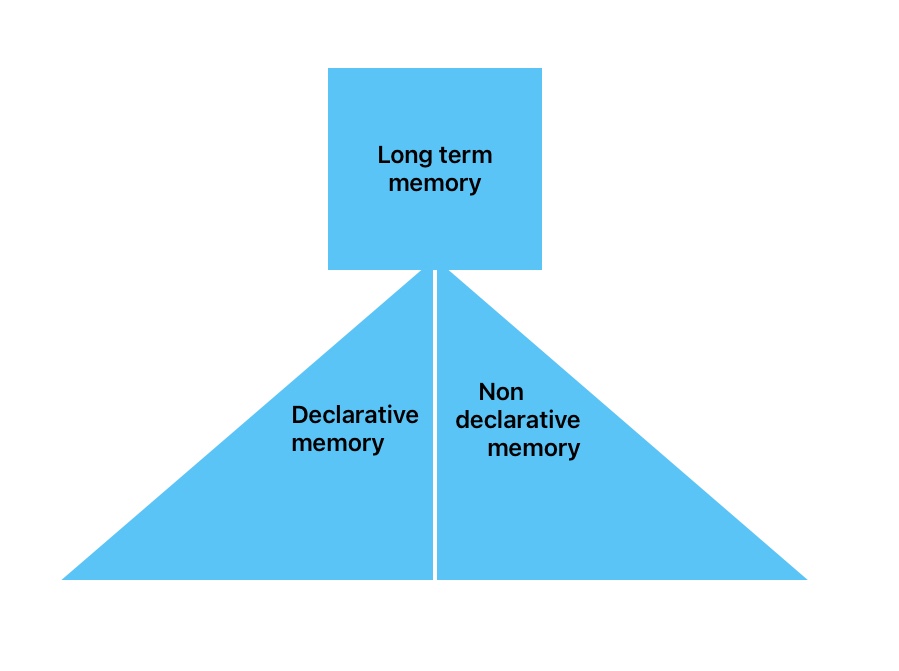
Declarative memory
=the ability of recalling events and facts consciously
Click here for more
Non declarative memory
= skills or behaviours obtained from past learning and experiences that are expressed by their performance and not their recollection
Click here for more
Both of them have subcategories.
Click on the system you want from above to learn more!
They are two distinct memory systems.
However, they both work to create and maintain behaviour and character.
One event can also create both kinds of memory.

For example, a scary event can create an episodic memory ( declarative ) and a phobia which can be included in simple classical conditioning ( non declarative ).
Which memory system is used can make us learn differently.
Such as in better or worse / conscious or unconscious learning / related to or distinct to other knowledge…
For habit learning tasks which were set at a high difficulty, participants of the experiment were found to use the medial temporal lobe, used for declarative memory, at the beginning.
However, this reliance gradually decreased and the activation of the neostriatum, used for procedural memory was gradually increased.
Next Part : Until the current systems of memory

 Accessible Science
3 Comments