Evidence supporting the blood type-personality relation. Are they legit ?

Introduction

This page is the 2nd part of a study of articles.

Blood type and personality by Mary Rogers and A. Ian Glendon

A Pilot Study Using AI for Psychology: ABO Blood Type and Personality Traits by Masayuki Kanazawa

Recent findings supporting the relation.

Since Furukawa, many different researchers have done experiments with various tests and methods to try and prove that our blood type can be predictive of our personality.

An experiment done using the high school personality questionnaire, for A, found As to be more tender minded than others.

This experiment was also criticised.

Another using the 16 Personality Factor on Australian residents found As to have significantly higher self-sentient integration and anxiety than Os.

However, they weren’t able to find any significant differences comparing with the other blood types.

A researcher called Eysenck did several experiments comparing the traits of populations and their blood type proportions finding :

  • More emotional behaviours in Bs than As
  • ABs to be more introverted than others
  • The proportion of Bs varying consistently with anxiety and neuroticism of the population
  • The proportion of ABs varying consistently with introversion of the population

Extraversion

In 1967, experiments found O and ABs to have significantly higher extraversion while As and Bs had significantly higher introversion.

7 years later another researcher found Bs to have high neuroticism, As to be more emotionally vulnerable and ABs to have high introversion.

This contradicts research done by the same person in the same year that said ABs were aggressive, open and extraverted. It also contradicts the research done in 1967 presented above.

Later, research started including gender differences and found O females to be more extraverted than A females while O males were less than A males.

Regarding neuroticism, a study found females to have higher neuroticism than males and Bs to have higher neuroticism than other blood types.

A study in 2001 used the MBTI ( Myers-Briggs type indicator ) and found :

  • O : extraverted
  • A : introverted
  • B : independent
  • AB : intuitive

Summary of these findings

Many of the results were inconsistent and some would even contradict each other.

In addition, most experiments are criticised as being poorly designed, having inconsistent methodology and problematic interpretations.

Next Part :

part 1 : The root of the Blood type – personality relation

The root of the Blood type – personality relation

Introduction

Blood types are facts many of us know about ourselves. In certain cultures, such as Japan or South Korea, blood types are thought to determine personality traits.

This page is the first part of a study of articles.

Blood type and personality by Mary Rogers and A. Ian Glendon

A Pilot Study Using AI for Psychology: ABO Blood Type and Personality Traits by Masayuki Kanazawa

Please do read until the end, especially for this article as it may cause wrong information to be spread.

Context

40% of our personality is genetic, meaning it wouldn’t be weird that our blood types as in A, B, AB or O had an influence on our personality.

The relation of blood type and personality has been hypothesised since the times of Hippocrates.

Hippocrates believed in 4 types of bodily humours that would represent personality.

The 4 bodily humours

Sanguine, phlegmatic, choleric and melancholic.

The first studies to be done about this topic in the modern scientific world were by a japanese researcher called Furukawa in 1927.

The findings of Furukawa

  • Os and Bs are active people being aggressive, progressive and positive
  • As and ABs are passive people being conservative, defensive and negative

Individually,

  • Os have temperamental characteristics being optimistic, sociable and strong willed.
    This puts them i the phlegmatic category of Hippocrates.
  • As are melancholic being shy, docile, diffident, worrying, reserved and impressionable.
  • Bs are sanguine as they are frank, light hearted, cheerful, sociable, quick and attentive.
  • However, ABs had temperaments that were hard to put into a category

However, a different researcher argued that the methods an the use of the statistics in this research wasn’t done properly and found no relation of blood type and different aspects of the human mind.

These aspects being intelligence, emotion, idiosyncrasies and personality.

Idiosyncrasy

A way of behaviour, thought etc that is specific to the individual

Next Part : Evidence supporting the blood type-personality relation. Are they legit ?

Part 3 :

Part 4 :

Is memory acquisition or reconsolidation the problem in Alzheimers ?

Introduction

This page is the third part of a study of the article

Failures to reconsolidate memory in a mouse model of Alzheimer’s disease

by Masuo Ohno

Experiment number 2

To test the cause of the memory impairment ( aquirement or consolidation issue ), the second experiment increased the number of training.

Originally, the mice were trained with 2 shocks.

1)Put in the room

2) 3 minutes free to do anything

3) unsigned electric footshock

4) 1 minute free

5) unsigned electric footshock

6) 30 seconds free before being taken out of the room

This was changed to 5 shocks of the same strength.

The results

In this case, even the older mice were showing freezing behaviours. This meant the acquisition of memory and initial consolidation was not affected as much.

2 hours later, the mice were again put in the room and this showed different behaviours with age.

While the youngest mice of 3 to 4 months of age showed no change in their response to being put in the room, the mice over 10 months showed less freezing.

Although weaker, this effect of reduced freezing was also found in the mice of 6 to 7 months of age.

These results were interpreted to show the mice who had a more developed Alzheimers disease had a strong impairment in memory reconsolidation. The restabilisation of memory after retrieval.

Remote memory

As memories grow older, they normally become less dependent of the hippocampus and more so of the cortical networks.

This process happens gradually with several cycles of reconsolidation and retrieval.

this means the older transgenic mice wouldn’t be able to create remote memories as they aren’t able to restabilise memories.

However, remote memory deficits were found in even in young transgenic mice less thsan 4 months of age.

This is thought to be because Aβ fills the cortical areas at a faster rate than the hippocampus, blocking its normal functioning.

Part 1 : A fourth stage of memory consolidation & model mice

Part 2 : Memory of 5xFAD APP/PS1 transgenic mice

Memory of 5xFAD APP/PS1 transgenic mice

Introduction

This page is the second part of a study of the article

Failures to reconsolidate memory in a mouse model of Alzheimer’s disease

by Masuo Ohno

Context

The model mice for this experiment were 5xFAD APP/PS1 transgenic mice.

These mice carry 5 total mutations in genes for APP production and PS production ( 3 and 2 mutations) to recreate human Alzheimers disease.

All five mutations cause an increase in Aß, especially the type called Aß42 in the brain.

Beta Amyloid 42

A type of Aß that has neurotoxic effects

This leads to plaques that would take even 6 to 12 months to form in other transgenic mice, to develop in 2 months.

Aβ has been observed to start settling itself in the subiculum of the hippocampus and the 5th layer of the cortex.

Subiculum

a region next to the dentate gyrus involved in memory retrieval and encoding of our surroundings

However, by 6 months, most of the hippocampus and the cortices of the transgenic mice were found to be filled with the peptide. This explains a part of the results from the experiment.

The experiment

Transgenic mice of 3 to 4 months, 6 to 7 months and 10 to 15 months were trained to associate a certain room with an electric shock.

24 hours later they were placed in that same room again. In this situation, normal mice will remember this room and show freezing behaviour.

The memory issues arising from around 6 months may be caused by Aβ filling certain brain areas, especially the hippocampus, in that time.

The youngest group of mice did too. The problem was in the older mice. Mice from 6 months of age froze less, meaning the association was no more, or at least less, in their brains.

This result however still has several possible explanations.

The decrease in freezing behaviour could be due to an issue in memory acquirement ( the perception ) or in memory consolidation ( the creation of a long term memory ).

The second experiment allows us to see which is true.

Part 1 : A fourth stage of memory consolidation & model mice

Next Part : Is memory acquisition or reconsolidation the problem in Alzheimers ?

A fourth stage of memory consolidation & model mice

Introduction

Alzheimers disease is one of the most well known diseases. We know it affects our memory. However, we still don’t know what part of memory if not all of it.

This page is the first part of a study of the article

Failures to reconsolidate memory in a mouse model of Alzheimer’s disease

by Masuo Ohno

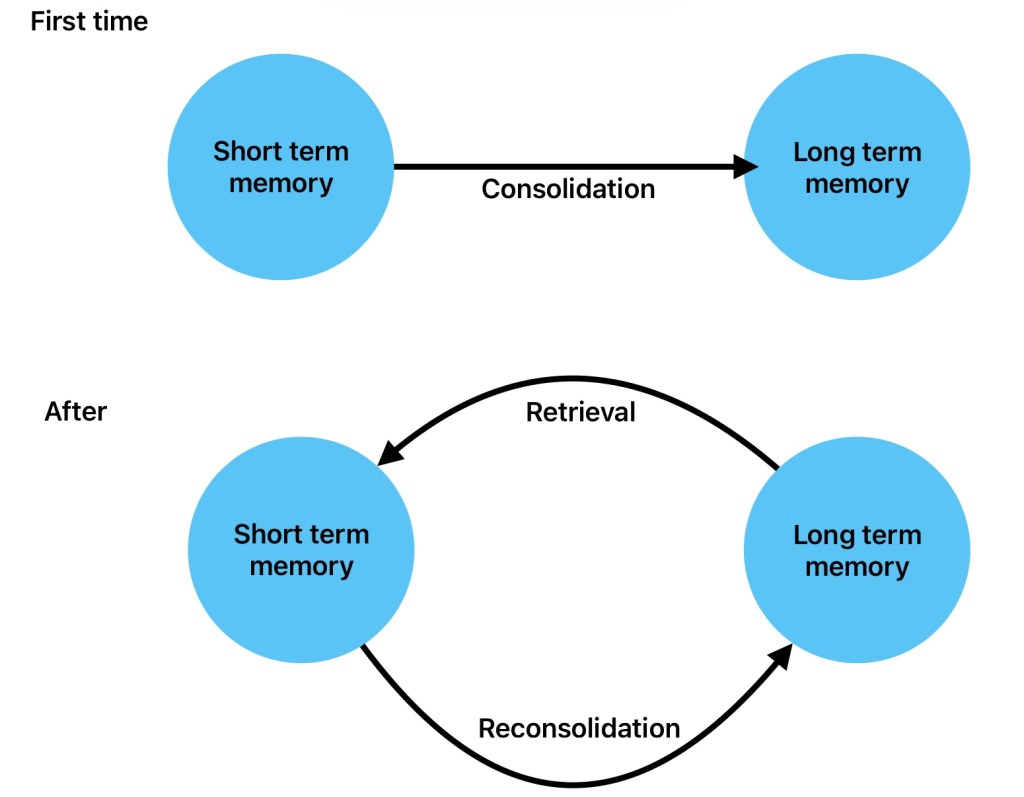
Memory reconsolidation

One of the first signs of Alzheimers disease is the increased difficulty in forming new memories and retaining new information.

This may be caused by a problem in any of the 3 stages of consolidation :

Consolidation

= the process of making a working memory / short term memory into a long term memory

Encoding, storage or retrieval

Retrieval isn’t just about making the information usable, it makes it easier to be changed or to link additional information to it.

After retrieval, the memory that has been destabilised doesn’t disappear. It gets restabilised by the synthesis of proteins.

The destabilisation and restabilisation together are the process of memory reconsolidation.

This process has been found to use different brain regions as the original consolidation proving it as a distinct process.

The relation of Alzheimers disease and this “fourth stage” of consolidation hasn’t been studied as much as the other three which is what this article does.

Alzheimers disease model mice

As their are many difficulties when experimenting with humans, many experiments including this one use animals such as mice to test their ideas.

Mice that have been modified genetically to be as close as possible to human with Alzheimers were used.

These are called Alzheimers disease model mice.

Usually, they have a higher than normal expression of the amyloid precursor protein ( APP ), presenilin ( PS ) and/ or tau genes.

These changes are able to cause

  • Beta Amyloid ( Aß ) deposits
  • neurodefibrillary tangles
  • gliosis and synaptic degeneration
  • memory deficits

Beta amyloid

A protein produced from the amyloid precursor protein (APP)

Some subtypes such as Aβ42 are considered to be neurotoxic

Neurodefibrillary tangle

The abnormal accumulation of the protein tau in neurons

Gliosis

The production of glial cells that normally occurs to repair the brain/ spinal cord after an injury

Like in humans.

Memory was measured by use of contextual far consolidation as it is one of the best ways to evaluate animal memory.

Next Part : Memory of 5xFAD APP/PS1 transgenic mice

Part 3 :Is memory acquisition or reconsolidation the problem in Alzheimers ?

Memories forever in our brains

Introduction

This page is the fourth part of a study of the article

Engineering a memory with LTD and LTP

by researchers from the university of California at San Diego and the Howard Hughes Medical Institute

Summary

Thus article presented 2 experiments, both using cued fear conditioning on rats trained to press a lever.

A virus was used to insert receptors sensitive to light to be able to make a light directly to the brain be a CS.

This CS was associated to an electric shock and the conditioned response was less pressing of a lever.

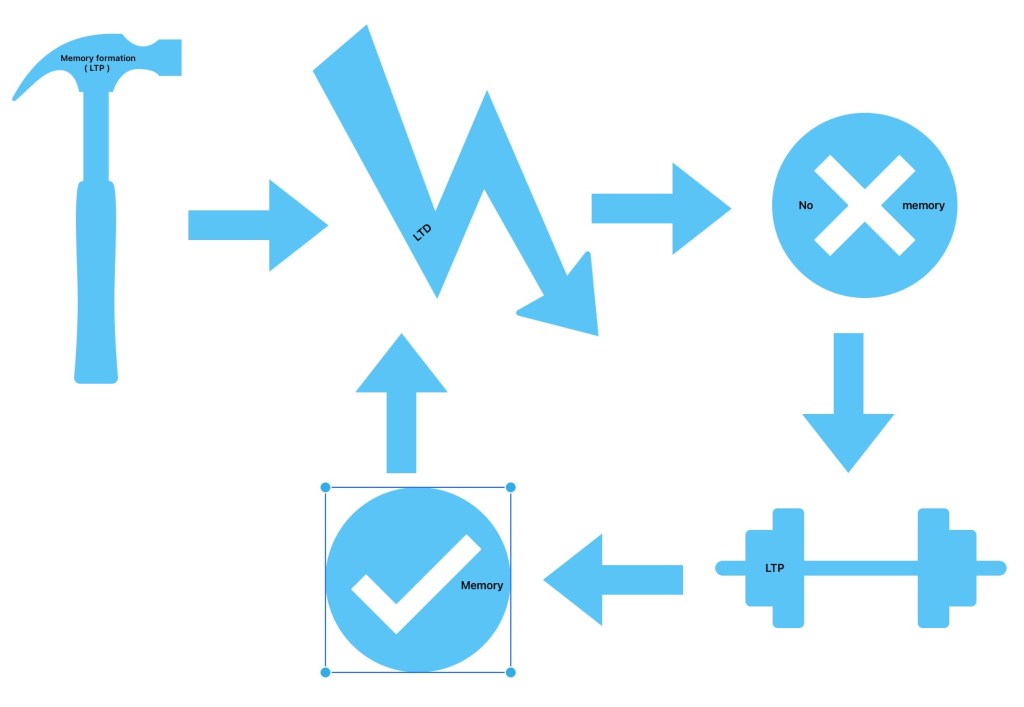
With the 2 experiments , we can conclude 2 things by assuming that LTO and LTD is the mechanism of memory.

1) A memory once formed in the brain is still there even if we can’t remember it.

The induction of LTD in memory was able to block the association and the CR. However, this was reinstated by LTP.

If a memory is caused by LTP and is forgotten by LTD, This result shows that even after being forgotten, there is no need of recreating the memory from nothing.

All that needs to be done is the restrengthening of the memory.

2) Extinction is or the creation of a new memory or a way to completely erase the previous memory

In the second experiment, they caused an extinction of the fear conditioning.

In this case, unlike all the results until then, the CR didn’t reappear after LTP induction.

This leaves 2 possible cases.

The extinction caused a new stronger memory saying the tone isn’t associated with the shock.

However, if it was a distinct new memory, the LTP induction would have caused the associating memory to be stronger thus the CR would have come back.

This means in this case, it was more probable that the original memory was changed from “ tone = electric shock “ to “ tone = no electric shock”.

The original memory was completely erased.

This means instead of an association of “ tone = no electric shock” appearing, the original association completely disappears during the process of extinction.

For this to happen, neural connections and circuits of this memory have to be fully cleared.

However, this would be a problem following the first conclusion we reached.

If this is the case, maybe LTP isn’t the mechanism of memory at all…

Part 1 : What is fear conditioning and how is it used ?

Part 2 : Finding LTP in conditioning

Part 3 : The brain and memory, simple but complex engineering

The brain and memory, simple but complex engineering

Introduction

This page is the third part of a study of the article

Engineering a memory with LTD and LTP

by researchers from the university of California at San Diego and the Howard Hughes Medical Institute

Engineering

With the ratio of AMPAR to NMDAR response in the synapses and the problem of the NMDAR inhibitor, it can be deduced that LTP is what has created the memory of the optical CS and the shock.

It would be logical to think that LTD, the other constituent of neural plasticity could do the opposite.

The rats who had received paired conditioning ( had formed the LTP in the lateral amygdala ) had an optical LTD induction.

( The LTD induction was done by giving the rats light pulses at a specific frequency, LTP induction was also done in a similar way but with a different frequency and a different number of pulses )

This was able to erase the memory. The rats showed normal pressing of the lever, similar to before they were given cued fear conditioning.

The researchers decided to go on with the experiment and gave the rats with the erased memories an optical LTP induction.

Again, this made the memory reappear.

This cycle could be repeated more times with the same effects and the effects of LTP or LTD were also found to be long term.

They also did the same thing on rats that weren’t conditioned by giving light to the same brain regions and these rats didn’t show any change.

This finding shows us that the optical CS wasn’t activating the neurons for pressing the lever but was playing around with the electric shock – light association.

The second experiment

This was the same experiment as the first but with the optical CS replaced with a tone.

The results were the same.

However they were able to make one additional finding.

After successfully conditioning the rats to associate the tone with an electric shock, they gave the tone multiple times without the shock.

They caused an extinction of the association.

This eventually causes the rat to lose the conditioned response.

However, what was interesting was that LTP wasn’t able to make the CS reappear.

Therefore proving that extinction isn’t equal to LTD.

Next Part : Memories forever in our brains

Part 1 : What is fear conditioning and how is it used ?

Part 2 : Finding LTP in conditioning

Finding LTP in conditioning

Introduction

This page the second part of a study of the article

Engineering a memory with LTD and LTP

by researchers from the university of California at San Diego and the Howard Hughes Medical Institute

Experiment number 1

The base conditions

The rats were first trained to press a lever in response to a cue. Then they were conditioned to associate a tone with an electric shock to the foot.

This led to a CR, less pressing of the lever after the tone.

Manipulation of the brain

This tone was then replaced with a light flashed directly to a region of the brain ( the axon terminals of the lateral amygdala ).

The researchers injected viruses in the rats brain. These viruses were adeno associated viruses holding a variation of a Cholinergic receptor called ChR2.

This variant is sensitive to light and its channel are activated by a light instead of being fully dependent on certain kinds of molecules.

The viruses reached the geniculate nucleus and the auditory cortex and spread to the axon terminals of the lateral amygdala where the neurons received the receptors.

The results

As a control experiment, they first gave, only the light to the brain ( optical CS ).

This as expected did nothing to the rats and they continued to press the lever as before.

Then, they gave an electric shock with the optical CS.

This cued fear conditioning was able to cause the rats to stop pressing the lever during the optical CS as expected.

However, this association of electric shock and light was susceptible to extinction

Extinction

= the loss of the CR after repeated exposure of the CS without the US

and was blocked by a NMDA receptor inhibitor.

Inhibitor

= a molecule that blocks the receptor and it’s functions

The blocking of cued fear conditioning, a type of memory, due to the receptors inhibitor shows the need of the NMDA receptor and maybe LTP/LTD for memory.

NMDA receptor

= an ionotropic glutamate receptor involved in most kinds of synaptic plasticity.

It is thought to be the main receptor for LTP and LTD

The activity of the synapses can come from AMPA receptors or NMDA receptors. The ratio of the response from AMPARs to NMDARs can be used to see the occurrence of LTP.

After conditioning of the optical CS and the shock, rats with paired conditioning had a higher ratio of AMPAR to NMDAR response in the amygdala than unconditioned rats or rats with unpaired conditioning.

Paired conditioning

= conditioning when a stimulus is paired to another

Ex : do A and be rewarded by B

Unpaired conditioning

= conditioning when a stimulus is paired with the absence of another

Ex : do A to not get B

Showing that LTP had happened where the light was flashed at in the group of rats with paired conditioning.

The next part of the results is where the engineering begins.

Next Part : The brain and memory, simple but complex engineering

Part 1 : What is fear conditioning and how is it used ?

Part 4 : Memories forever in our brains

What is fear conditioning and how is it used ?

Introduction

Although we still don’t know how memories are created and kept in the brain, we do have a theory that seems pretty close. These are LTP and LTD.

This page is the first part of a study of the article

Engineering a memory with LTD and LTP

by researchers from the university of California at San Diego and the Howard Hughes Medical Institute

Context

The main theory in the neuroscience of memory is that memory is represented by modifications of synaptic strengths.

The two most common examples are :

LTP and LTD

These mechanisms of neural plasticity are said to be done by the cells themselves.

However, this theory is yet to be fully proven.

The experiments in this article don’t prove the theory but show results strengthening the position of neural plasticity as a mechanism for memory.

Both experiments used cued fear conditioning in rats.

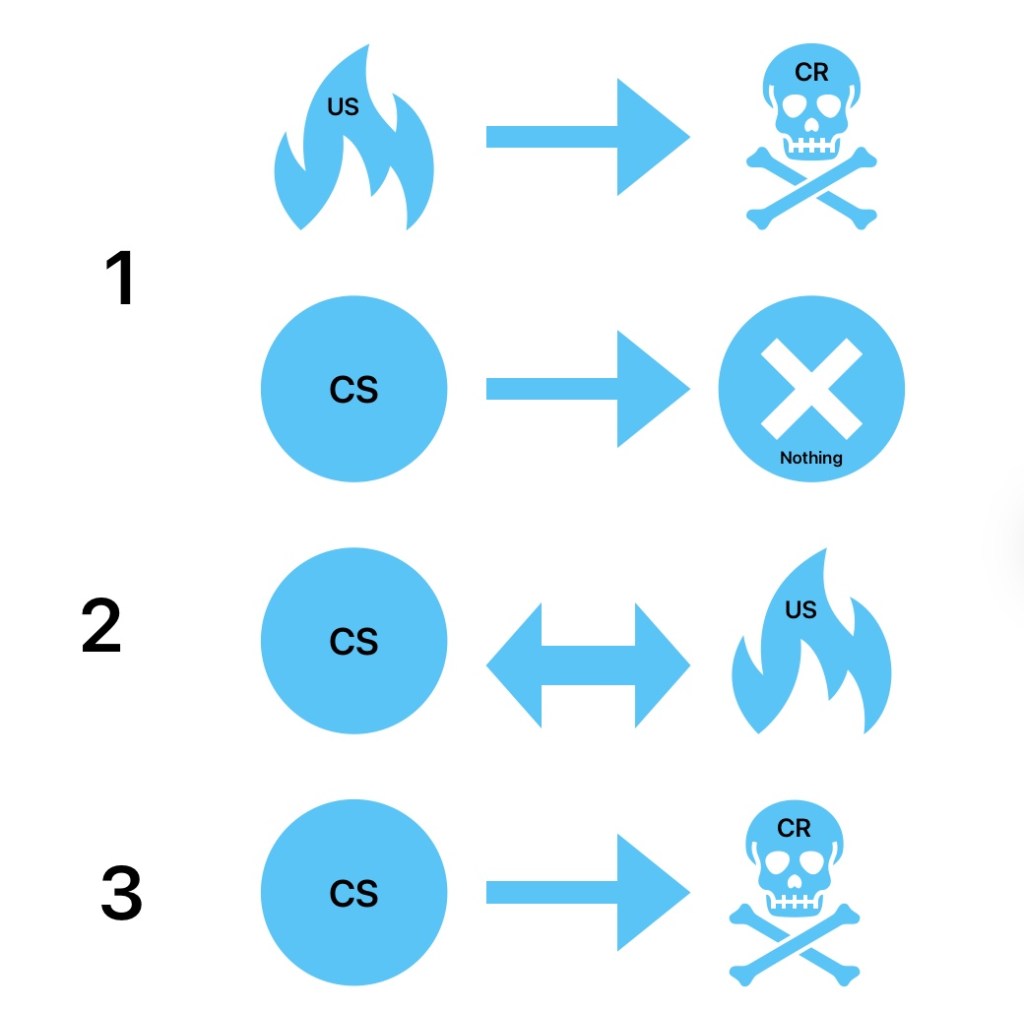
Fear conditioning

Fear conditioning is the association of an emotionally neutral something ( an activity, an object, a sound… ) with something unwanted ( like an electric shock or a uncomfortable noise ).

This causes the animal to react in a way it does to the unwanted stimulus ( the unconditioned stimulus, US ) in response to the neutral stimulus ( the conditioned stimulus, CS ).

In many cases, rats will be trained to associate electric shocks ( US ) with the pressing of a lever ( CS ) that they were trained to do before.

This causes a conditioned response ( CR ) which would be the reduction or complete stop of pressing the lever as they have associated the electric shock with the pressing of the lever.

Contextual fear conditioning is when the CS is a specific situation, place or environment.

Rooms with walls of a certain colour for example are used in experiments with rats.

On the other hand, cued fear conditioning is when the CS is a cue or a sign. A sound, a light turning on or any little change can do the job.

Fear conditioning is said to be one of the best ways for research on animals memory.

Part 2 : Finding LTP in conditioning

Part 3 : The brain and memory, simple but complex engineering

Part 4 : Memories forever in our brains

Until the current systems of memory

Introduction

Memory, being an ability with many components, is a complicated process. It has been studied for a long time and various theories, ideas have been presented.

This page the 2nd part of a study of the article

Memory systems of the brain : a brief history and a current perspective by LR Squire

Context

The current idea of memory is a multi memory system, with different kinds of memory.

This has existed for a long time although the memory systems weren’t the same.

However, two discoveries have led to the current version.

1. The distinctions between :

  • Associative memory and recognition memory
  • Contextual retrieval and habit
  • Taxon and locale memory

This discovery, found on animals, was one of the earliest to show that the hippocampus and its nearby structures may be involved in one type of memory. Not all.

This idea was reinforced by the second discovery.

2. Non motor skill learning and retention in amnesic patients

They were able to find that people with amnesia were able to learn not only motor skills but some non motor skills as well.

For example, they showed signs of priming ( a form of memory ).

They were also able to maintain the learning.

This proved that memory has different types and each type uses different brain areas.

For example :

  • The cerebellum : involved in delay eyeblink conditioning
  • Neostriatum : involved in habit formation guided by gradual learning from feedback
  • Amygdala : involved in learning the association of a positive or negative emotional response to something

The development of neuroscience and the studies on memory created too many memory systems to fit into only two categories.

Thus creating the categorisation seen in part 1.

Part 1 : The biological systems of long term memory