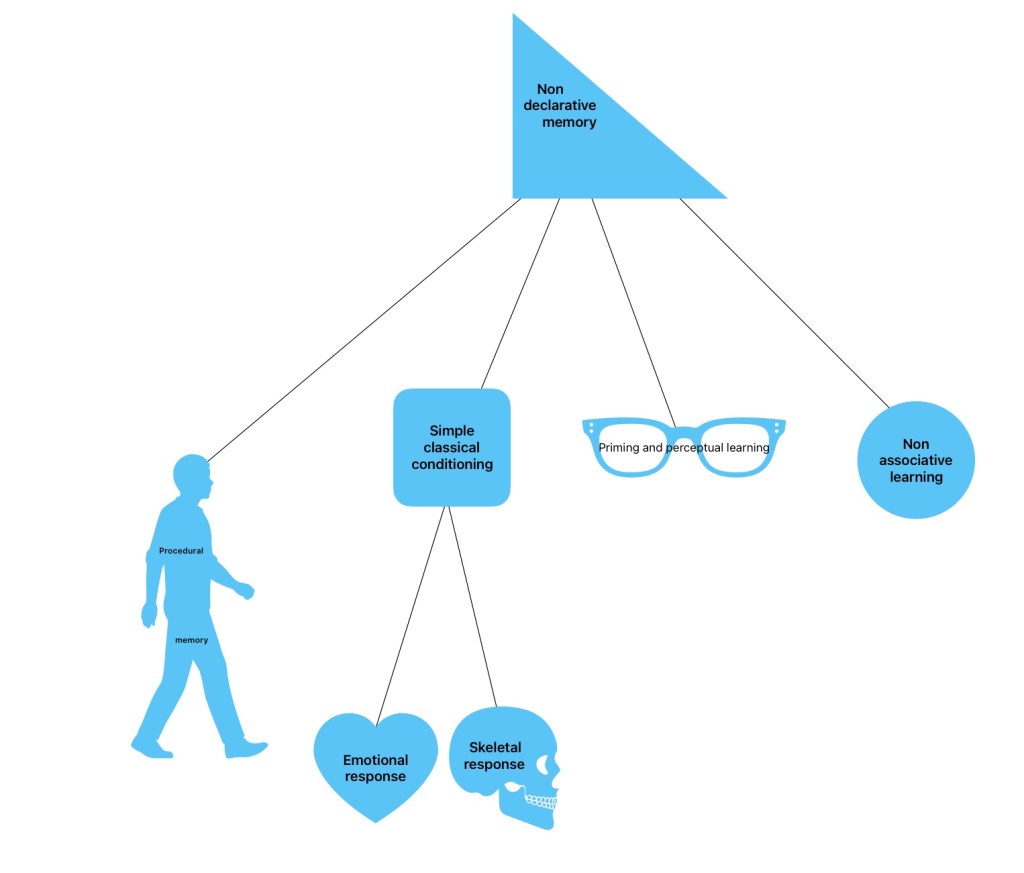
Non Declarative memory
=skills or behaviours obtained from past learning and experiences that are expressed by their performance and not their recollection
The learning of these kind of memories are done gradually by finding ant taking out common parts of similar events.
This learning is usually done unconsciously.
One example is learning to ride a bike.
By riding it multiple times, the individual will, unconsciously, start riding it in ways that doesn’t make them fall and not do things that make the, fall.
The four subcategories of non declarative memory are :
Procedural memory
= cognitive and motor skills or abilities
Often used example are knowing how to ride a bike or how to run
It’s main region is the striatum
Priming and perceptual learning
= when a perceived item unconsciously influences behaviour, actions or thoughts in response to later events and objects
For example, when hungry, an individual will recognise food related words faster than non food related words.
The main region used is the neocortex.
Non associative learning
= learning that doesn’t involve conditioning or any association. It has two subtypes : habituation and sensitisation.
Habituation is getting used to something and recognising it less, like the noise of cars when living next to a busy road
Sensitisation is the opposite where the reaction to something gets stronger and stronger.
The main region activated is the reflex pathways

Simple classical conditioning
= when an item, sound, smell… causes an unrelated response due to repeated association of it with something else.
Pavlovs dog is a famous example where the dogs would produce more saliva in reaction to a bell sound after many experiences of hearing it before being given food
Simple classical conditioning has two subtypes.
Emotional response
The amygdala is the main region for this.
Skeletal response
= a physiological response
The cerebellum is mainly activated.

 Accessible Science
2 Comments