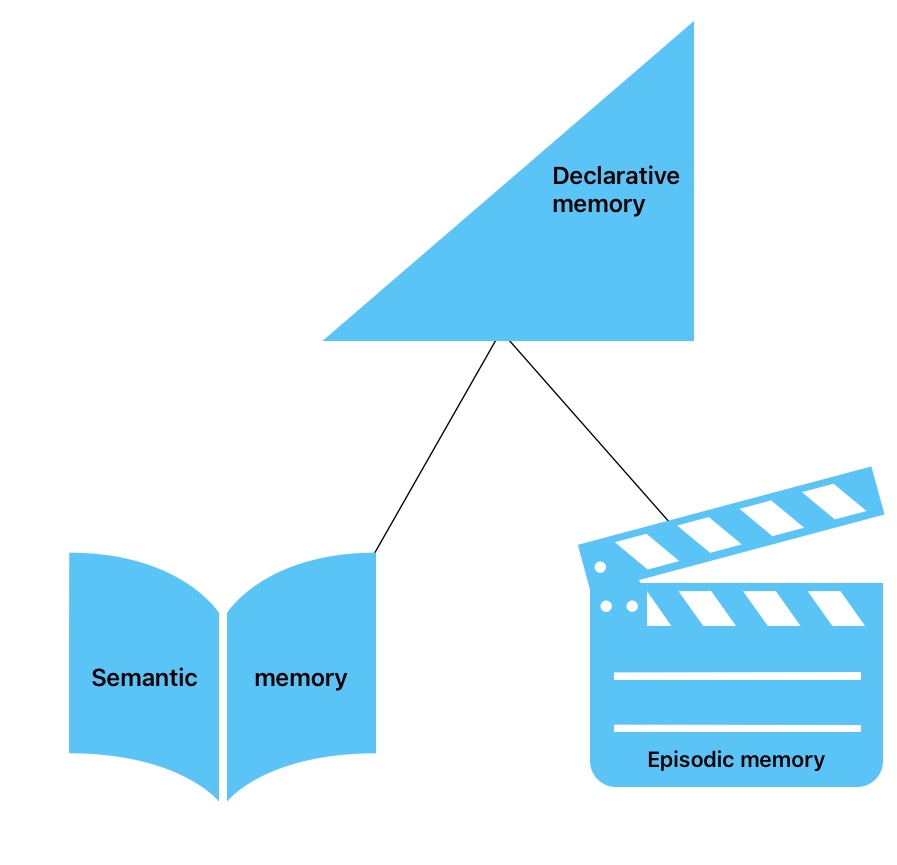
Declarative memory
= the ability of recalling events and facts consciously
Declarative memory mainly uses the medial temporal lobe and the diencephalon
Medial temporal lobe
=a part of the temporal lobes ( in the sides of the head ) that has the hippocampus, amygdala and Parahippocampal regions and is important in memory and learning
Diencephalon
=a brain region consisting of the epithalamus, hypothalamus, thalamus and subthalamus.
It is in a central position in the brain. It relays information to the cerebral cortex and releases hormones.
It is the main memory system to be damaged by amnesia.
Amnesia
= partial or complete loss of memory/ memory ability
The conscious aspect is important in defining declarative memory and enables the use of retrieved information such as comparison or contrasting.
The two subcategories of declarative memory are :
Semantic memory
= knowledge, information about things that get recalled independently of a past experience

Episodic memory
= a memory of an event in the past experienced directly
While they both use different content, episodic memory can also be seen as semantic memory with additional information about the context.
This may be why episodic memory uses the same brain regions as semantic memory with the addition of other brain regions such as the frontal lobe.
Frontal lobe
= the front part of the brain involved in higher level executive functions such as language and thoughts.

 Accessible Science
4 Comments