Membrane potential
The difference in electric charge between the outside and inside of a cell. It is usually measured in mV( millivolts ).
Generally, it is considered to be positiv when the inside of the cell has a higher charge than the outside.
Science accessible to all and easy to understand.
The difference in electric charge between the outside and inside of a cell. It is usually measured in mV( millivolts ).
Generally, it is considered to be positiv when the inside of the cell has a higher charge than the outside.
A molecule released by glands that transmit signals to distant body parts by travelling in the bloodstream
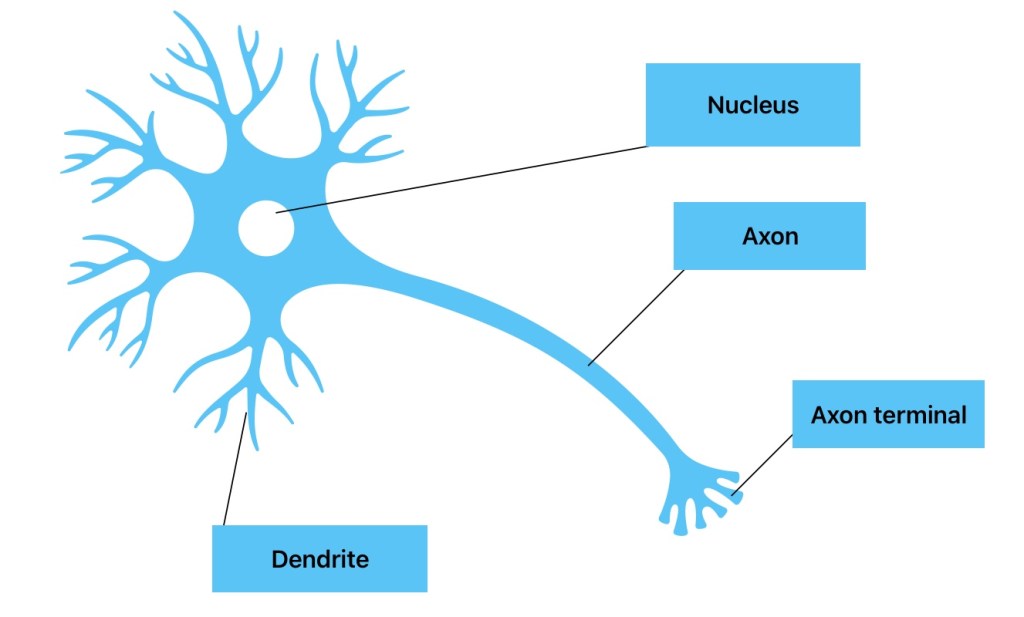
Cells mainly in the brain that send electric signals to send messages to other neurons and cells
A persistent weakening of a synapse causing it to be less likely to transmit the signals sent through it
A molecule released from a neuron into a synapse to transmit a signal
A molecule released by a neuron that acts in a similar way to both neurotransmitters and hormones as they transport signals to other neurons which don’t have to be connected by a synapse.
The mechanism behind the interaction of two neurons connected by a synapse.
Neurons release neurotransmitters from axon terminals.
The neurotransmitters bind to receptors on the dendrite of the other neuron.
The receptor then reacts to the neurotransmitter and through a mechanism that varies with each type of receptor, changes the membrane potential of the neuron.
Depending on the membrane potential, the neuron will repeat this process with the next neuron or not.
A persistent strengthening of a synapse causing it to be more likely to transmit the signals sent through it.
This page is the fourth part of a study of articles.
Multilingualism seems to have many advantages and disadvantages.
This is probably due to the different organisation of languages in the brain.
In this final part, we will be looking at
Many models have been suggested to explain the brains’ structure and functions in multilinguals.
Some from a psychological perspective :
Others from a neuroscientific point of view :
However, as the brain is extremely complicated and far from being fully understood, no single one explains the whole story.

Brain imaging studies have been able to find interesting results too.
In bilinguals, the brain regions used in the processing of 2 different languages, overlap.
Late bilinguals were also found to use more regions in their less proficient language.
The brain regions used in language processing are areas controlling language and areas controlling executive functions. Many of the areas controlling language are also involved in cognitive control processes.
These areas and the functions related to them seem to explain the so called “bilingual advantage” outside of language ( such as in executive or cognitive tasks ).
Many of these areas, when comparing monolinguals and bi/multiliniguals are bigger or more dense.
For example, many areas of grey matter such as the ACC ( anterior cingulate cortex ), putamen, cerebellum, caudate and thalamus in addition to several white matter areas and brain networks have shown significant differences.
Putamen
Involved in suppression that enables the use of the appropriate language
Caudate
Involved in the management of lexical-semantic sets
These differences are dependent on the proficiency of both or all languages. They are also reliant on the age of acquisition of the non native languages but to a smaller degree.
The correlation of changes in the brain and age of acquisition may be because of the way the language is learned.
The author of the first article suggests that language is learned more implicitly at a young age and more explicitly when older.
However, the age of acquisition had no effect on the volume of the caudate, suggesting the effect of the age of acquisition or proficiency may be different depending on what the area is involved in regarding language.
Overall, being able to speak several languages has both many advantages and disadvantages regardless of the age at which someone starts to learn. The advantages seem to overweigh the disadvantages in many aspects : social, language and executive.
Knowing that our brains can become distinct from others by learning a new language is very exciting to know.
Many articles and experiments have been written and done in this field but with still so much to learn.
It would be even more interesting for example to know how the brain organises several languages, are all languages given a specific network even for speakers of 3 or 4 or even more languages ?
What other non language related skills and abilities could multilingualism have an effect on ?
These are a few of the so many questions left to answer…
Part 1 : The problems of multilinguals
This page is the third part of a study of articles.
The advantages of being bilingual are often studied in younger children.
Thus, these benefits may seem to only apply to people who have grown up and developed their brain using two or more languages.
However, the third study, as in its title, has compared the effects in early bilinguals and late bilinguals.
This study found that by comparing both groups and monolinguals, both groups of bilinguals had similar levels of disadvantage in the speed and accuracy of generating words.

They also found the same degree of advantage in non verbal executive function.
Both early and late bilinguals showed less conflict effects than monolinguals in the attentional network task.
These results show that various pros and cons of speaking multiple languages will appear at a similar level for both children and early adults learning another language.
Although some studies find no effects on late bilinguals, the author points out to the fact that the proficiency of these “bilinguals” was only self reported and not verified.
It is common that people overestimate their own level of proficiency in a language and many changes in the brain coming from being multilingual depend on the level of acquisition.
Part 1 : The problems of multilinguals
Part 2 :The unknown effects of multilingualism
Next part : Multilingual brains, are they any different?

 Accessible Science