Introduction
Alzheimers disease is one of the most well known diseases. We know it affects our memory. However, we still don’t know what part of memory if not all of it.
This page is the first part of a study of the article
Failures to reconsolidate memory in a mouse model of Alzheimer’s disease
by Masuo Ohno
Memory reconsolidation
One of the first signs of Alzheimers disease is the increased difficulty in forming new memories and retaining new information.
This may be caused by a problem in any of the 3 stages of consolidation :
Consolidation
= the process of making a working memory / short term memory into a long term memory
Encoding, storage or retrieval
Retrieval isn’t just about making the information usable, it makes it easier to be changed or to link additional information to it.
After retrieval, the memory that has been destabilised doesn’t disappear. It gets restabilised by the synthesis of proteins.
The destabilisation and restabilisation together are the process of memory reconsolidation.
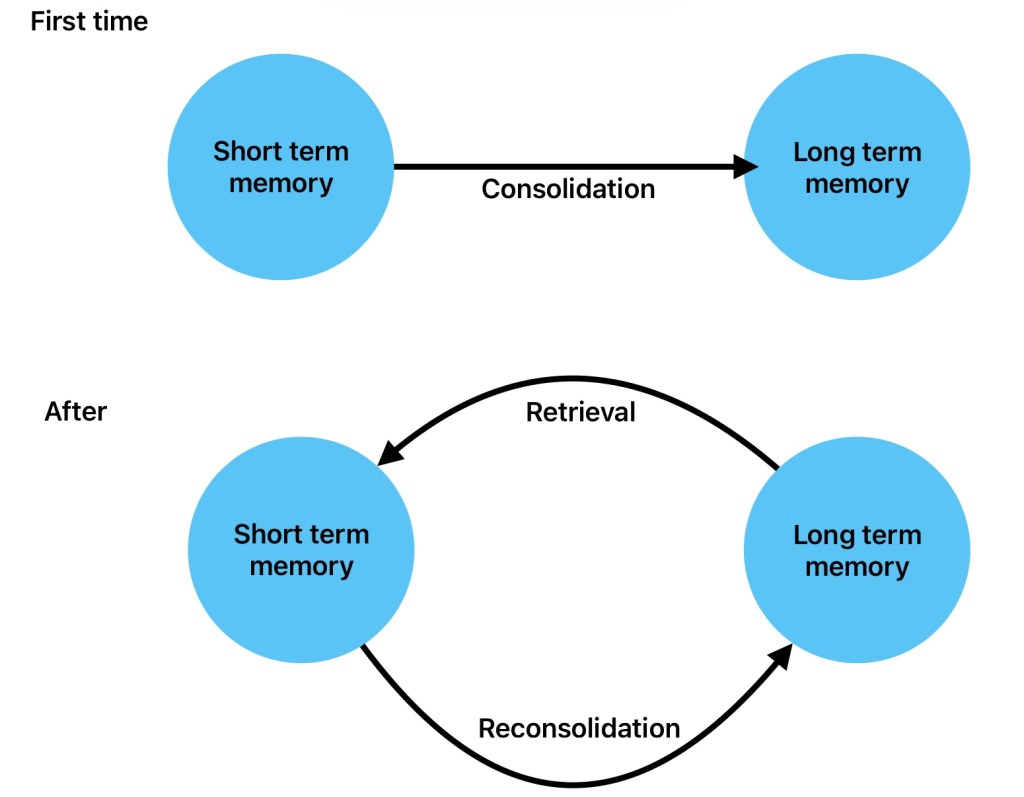
This process has been found to use different brain regions as the original consolidation proving it as a distinct process.
The relation of Alzheimers disease and this “fourth stage” of consolidation hasn’t been studied as much as the other three which is what this article does.
Alzheimers disease model mice
As their are many difficulties when experimenting with humans, many experiments including this one use animals such as mice to test their ideas.
Mice that have been modified genetically to be as close as possible to human with Alzheimers were used.

These are called Alzheimers disease model mice.
Usually, they have a higher than normal expression of the amyloid precursor protein ( APP ), presenilin ( PS ) and/ or tau genes.
These changes are able to cause
- Beta Amyloid ( Aß ) deposits
- neurodefibrillary tangles
- gliosis and synaptic degeneration
- memory deficits
Beta amyloid
A protein produced from the amyloid precursor protein (APP)
Some subtypes such as Aβ42 are considered to be neurotoxic
Neurodefibrillary tangle
The abnormal accumulation of the protein tau in neurons
Gliosis
The production of glial cells that normally occurs to repair the brain/ spinal cord after an injury
Like in humans.
Memory was measured by use of contextual far consolidation as it is one of the best ways to evaluate animal memory.
Next Part : Memory of 5xFAD APP/PS1 transgenic mice
Part 3 :Is memory acquisition or reconsolidation the problem in Alzheimers ?

 Accessible Science
2 Comments